The Five Forces of Organizational Coherence
Organizations are full of movement: information, decisions, pressure, meaning, work. The Five Forces offer a way to see how that movement holds together, where it begins to distort, and what those changes may already be revealing about the system.
A decision can leave the executive meeting feeling clear and arrive elsewhere in the organization as something much less certain. Two functions interpret it differently. A third keeps moving according to the previous priority because no one has said what should stop. Weeks later, leadership is surprised by uneven execution around a decision everyone believed had been understood.
You may recognize another version of this. A problem seems to appear suddenly, although people closer to the work have been compensating for it for months. Information existed. People were talking. Work was getting done. Yet something important was having difficulty moving through the system.
These moments are often separated into familiar categories. Communication. Capacity. Accountability. Resistance. Execution. Each may describe something real, while still leaving a larger question untouched: what is happening to the movement between them?
Organizations are full of movement. Information travels. Decisions travel. Pressure travels. Meaning travels. Work moves between people and functions. So do assumptions, uncertainty, confidence, fear, urgency, trust, and the consequences of choices made somewhere else in the system. None of this movement is neutral. It changes as it passes through relationships, structures, history, and pressure.
Energy is always moving somewhere. The question is whether the system is organizing that energy coherently.
Coherence gives us a way to look at that movement. It is not a fixed state an organization possesses. The conditions are continually changing, and the system continually reorganizes in response. Growth alters what people must coordinate. Pressure changes what can be heard. A leadership transition changes how authority and meaning travel. A decision made faster than the system can absorb it may alter several conditions at once.
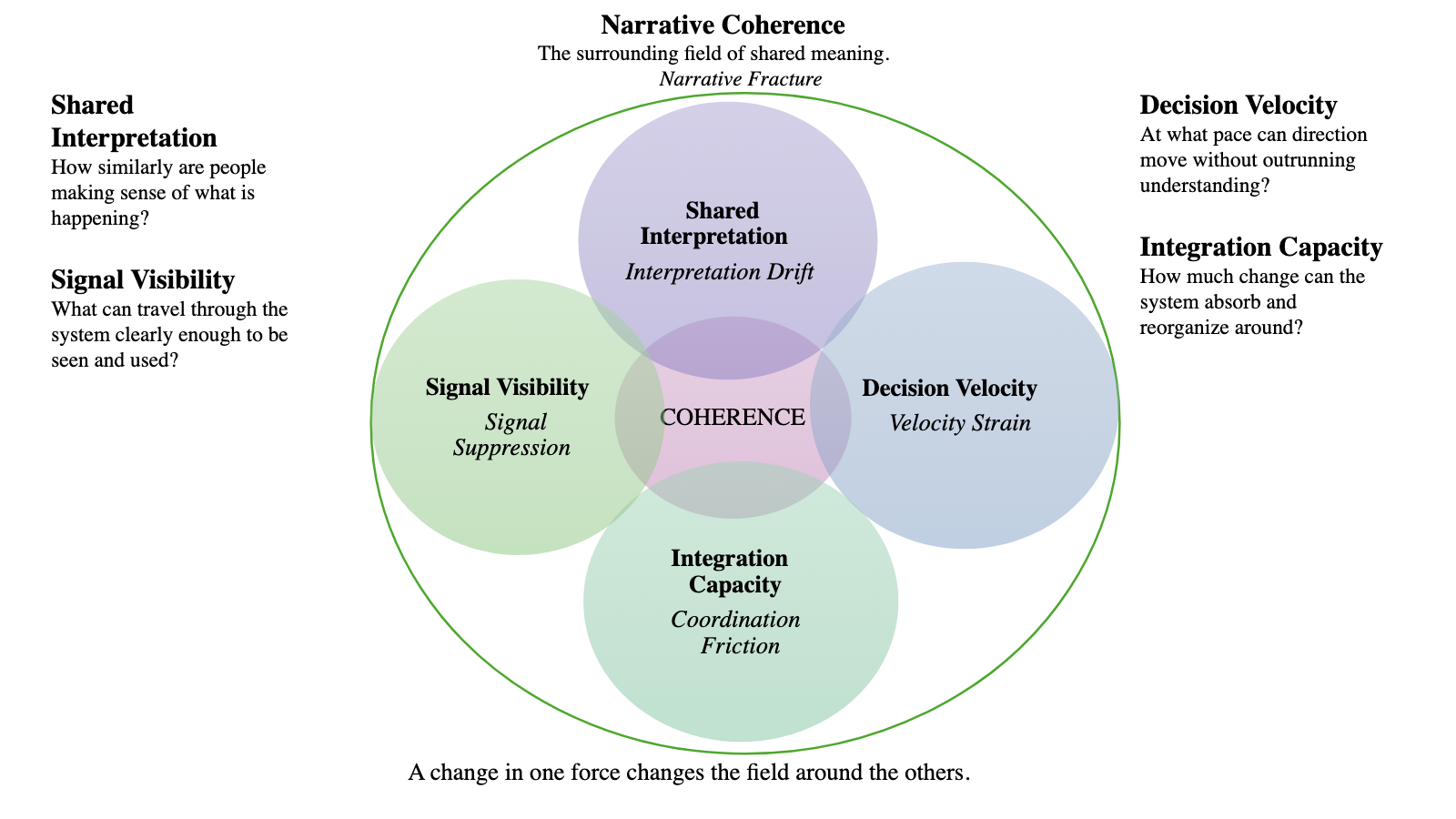
That interaction matters. The forces shaping coherence do not sit beside one another as separate categories. They act on one another. When interpretation begins to diverge, decisions may accelerate in different directions. When signals become harder to surface, leaders may make those decisions with less of the reality available to them. When the organization cannot absorb what is entering the system, people compensate, and those compensations begin generating new information of their own.
A change in one force changes the field around the others.
Five forces make that movement especially visible:
Shared Interpretation How similarly are people making sense of what is happening?
Signal Visibility What can travel through the system clearly enough to be seen and used?
Decision Velocity At what pace can direction move without outrunning understanding?
Integration Capacity How much change can the system absorb and reorganize around?
Narrative Coherence What shared understanding helps people know what the organization is becoming, and what the present moment means inside that story?
Signal Visibility
Sometimes the first person to recognize a problem is nowhere near the room where decisions about it are being made.
A customer-facing employee notices the same complaint appearing in different forms. Someone in operations has been working around a broken handoff for months. A manager has learned that a particular concern is unlikely to go anywhere, so they solve what they can locally and keep moving. By the time the issue reaches senior leadership, it may arrive as a surprise.
The organization knew before leadership knew. That distinction matters.
Information does not move through an organization simply because reporting channels exist. What travels depends on what people notice, what they believe is worth raising, where they expect a signal to go, and what experience has taught them will happen when it gets there.
Some signals travel easily because the system is designed to receive them. Revenue. Production. Deadlines. Customer counts. Other information is harder to transmit because it begins as something less certain: a pattern someone cannot yet prove, a hesitation, a change in tone, a workaround becoming routine, the meeting that has become unusually quiet.
These early signals often live closest to the work. They are also the easiest to lose.
People may soften them. Delay them. Carry them sideways to someone they trust. Wait for more evidence. Solve around them. None of those responses necessarily reflects indifference or poor communication. They may be reasonable adaptations to what the system has taught people about how information moves.
Over time, the adaptation itself can become difficult to see. Leadership receives increasingly finished information while the unfinished intelligence disappears from examination, never entering the leadership field of view. Problems look cleaner than they are. Concerns arrive after consequences make them undeniable. The organization can become quieter at precisely the moment it most needs to hear itself.
This is Signal Suppression.
Signal Visibility asks us to look beyond whether information is available. It asks whether emerging reality can move through the system early enough, clearly enough, and with enough of its original meaning intact to be useful.
The interesting place to look may be before the report, before the escalation, before the problem acquired a name.
What did the organization already know?
Decision Velocity
There are organizations in which a new problem can produce a decision almost immediately. The right people get on a call. Someone takes ownership. Direction goes out. From inside the leadership team, this can feel like one of the organization’s strengths: we are responsive, we do not get stuck, we know how to move.
Elsewhere in the system, the experience may be different.
The people receiving that direction may still be carrying the effects of the last decision. A team has begun reorganizing around one priority when another arrives. Someone who understood yesterday what mattered most is less certain today. Work already in motion does not disappear simply because leadership has changed direction.
This is where speed becomes more interesting.
Decision Velocity is not a measure of how quickly leaders can make decisions. It asks whether direction can move through the organization at a pace the system can understand, absorb, and act on without creating more confusion than momentum.
Sometimes fast is exactly right. A safety issue cannot wait for broad consultation. A market opening may require commitment before certainty is available. A crisis can make extended deliberation its own form of risk.
The question changes when speed becomes habitual rather than conditional.
Under sustained pressure, the distance between deciding and integrating can widen. Leaders experience movement. Teams experience accumulation. More decisions enter the system while earlier decisions are still being translated into work, and the capacity required to coordinate them begins competing with the capacity required to execute them.
This is Velocity Strain.
You may see it first in places that do not initially look like decision problems. Priorities remain active long after their strategic importance has changed. Meetings multiply to reconcile competing direction. A decision that appeared simple at the top requires repeated clarification farther into the organization. People become highly responsive while becoming less certain about what deserves their attention.
Speed has not necessarily increased movement.
It may have increased the amount of movement the system must absorb. That distinction matters because the value is not speed. The value is coherent movement.
The useful question may be less about how quickly the organization can act than about what happens after direction enters it.
How far can a decision travel before the system needs time to make meaning from it?
Integration Capacity
Some organizations have people who seem to know how to make almost anything work.
They know who to call when the formal process stalls. They remember why a decision was made six months ago and can explain it to someone who was not in the room. They know which spreadsheet contains the information the system does not connect, which approval can be accelerated with a conversation, and which two people need to speak before a handoff will actually happen.
These people are often enormously valued. They are experienced, responsive, resourceful. They carry context others do not have and solve problems before those problems become visible.
They may also be doing work the organization does not know it requires.
Every change entering a system has to be integrated. A new strategy must find its way into priorities. A new role changes relationships and decision rights. A new technology changes how work moves. Growth creates handoffs that did not matter when the organization was smaller. None of these changes ends when the announcement is made or the implementation plan is approved. The organization still has to reorganize around what has changed.
Integration Capacity is the ability of the system to do that work without requiring people to continually hold the pieces together themselves.
You can begin to see the difference by looking at what happens between the formal structure and the work as it is actually accomplished. How many decisions depend on someone knowing the history? How often does coordination require a particular person in the room? Where are teams maintaining parallel systems because the official one cannot yet carry what they need? What gets reconciled manually because two parts of the organization operate from different assumptions?
None of this means the people involved are doing something wrong. Quite the opposite. Their intelligence may be the reason performance continues to hold.
That is what makes the strain difficult to recognize.
The more capable people become at bridging structural gaps, the less visible those gaps can become to everyone else. A handoff works because someone checks it twice. A conflict between priorities does not reach leadership because a manager negotiates around it. A new initiative appears to land because teams quietly keep the old work running alongside it. What looks like organizational capacity may partly be human compensation.
Over time, that compensation accumulates. Coordination requires more memory, more conversation, more interpretation, more individual intervention. People spend increasing amounts of energy making different parts of the organization fit together before they can do the work those parts were meant to accomplish.
This is Coordination Friction.
It does not always look like dysfunction. Sometimes it looks like dedication. That may be the more revealing place to look.
Who in your organization has become exceptionally good at making the system work?
And what would become visible if they stopped compensating for it?
Narrative Coherence
Organizations carry stories long after anyone thinks of them as stories.
This is how we built the company. This is what customers come to us for. This is how decisions get made here. This is what good leadership looks like. This is what we protect when things get difficult.
Some of those stories are explicit. Others live in memory, habit, language, and the decisions people still refer to years later. They tell people what matters and help them interpret what is happening now.
That shared meaning becomes especially visible when the organization begins to change.
A founder steps back. A new generation assumes authority. Growth requires structures that were unnecessary when everyone knew one another. A company built around one kind of customer enters a different market. Technology changes the work faster than the organization has changed its understanding of the work.
The old story may still contain truth. It may also no longer be sufficient.
This is where Narrative Coherence becomes consequential. It is not the consistency of corporate messaging or whether everyone can repeat the strategy. It is whether people can locate the present inside a shared enough understanding of what the organization is becoming.
Without that shared meaning, reasonable people begin filling the gaps differently. One person experiences change as necessary evolution. Another experiences the same change as abandonment of what made the organization successful. Leadership believes it is creating the future. Others believe something important is being lost and cannot tell whether anyone else sees it.
Both may be telling the truth from where they stand.
Narrative begins to fracture when those meanings can no longer meet.
This is Narrative Fracture.
You may hear it in language before you see it in performance. People talk about “how we used to do things.” Different parts of the organization tell different versions of why a change is happening. A decision makes strategic sense to leadership but feels disconnected from everything employees have understood the company to value. The same history becomes evidence for opposing conclusions.
Narrative Coherence does not require one authorized version of the story. It requires enough shared meaning that people can understand how the past, the present, and the emerging future belong in the same conversation.
Perhaps that is why Narrative Coherence behaves somewhat differently from the other forces. It surrounds them. It influences how a decision is interpreted, whether a signal feels significant, how much change people believe they are being asked to absorb, and what all of that movement is understood to be for.
The question may not be whether people know where the organization is going.
It may be whether the story they are carrying can still help them get there.
The Forces Move Together
The Five Forces become most useful when we resist looking at them separately.
A decision enters the system quickly. People interpret what it means differently. The signals that might reveal that divergence do not travel upward. Teams begin compensating for competing direction, increasing the coordination required just to keep work moving. Eventually people develop different stories about why the organization feels harder to navigate than it once did.
Where did the incoherence begin?
There may not be one answer.
A change in one force changes the field around the others. Pressure moves between them. So does clarity. The system is continually organizing and reorganizing around what enters it, what it can absorb, what it can see, and what people understand that movement to mean.
This is why coherence is less interesting as a fixed condition than as a way of seeing.
Energy is always moving somewhere. The question is whether the system is organizing that energy coherently.
Once you begin looking through the Five Forces, familiar organizational experiences can become more legible. Alignment may contain several interpretations. Responsiveness may be creating accumulation. An indispensable person may be revealing work the structure cannot yet carry. A sudden problem may have been signaling itself for months. Resistance may contain information about a story that no longer holds together.
None of those observations tells you automatically what to do next. They do give you somewhere more specific to look.
What is moving through your organization now?
And what are the forces revealing about how the system is carrying it?